
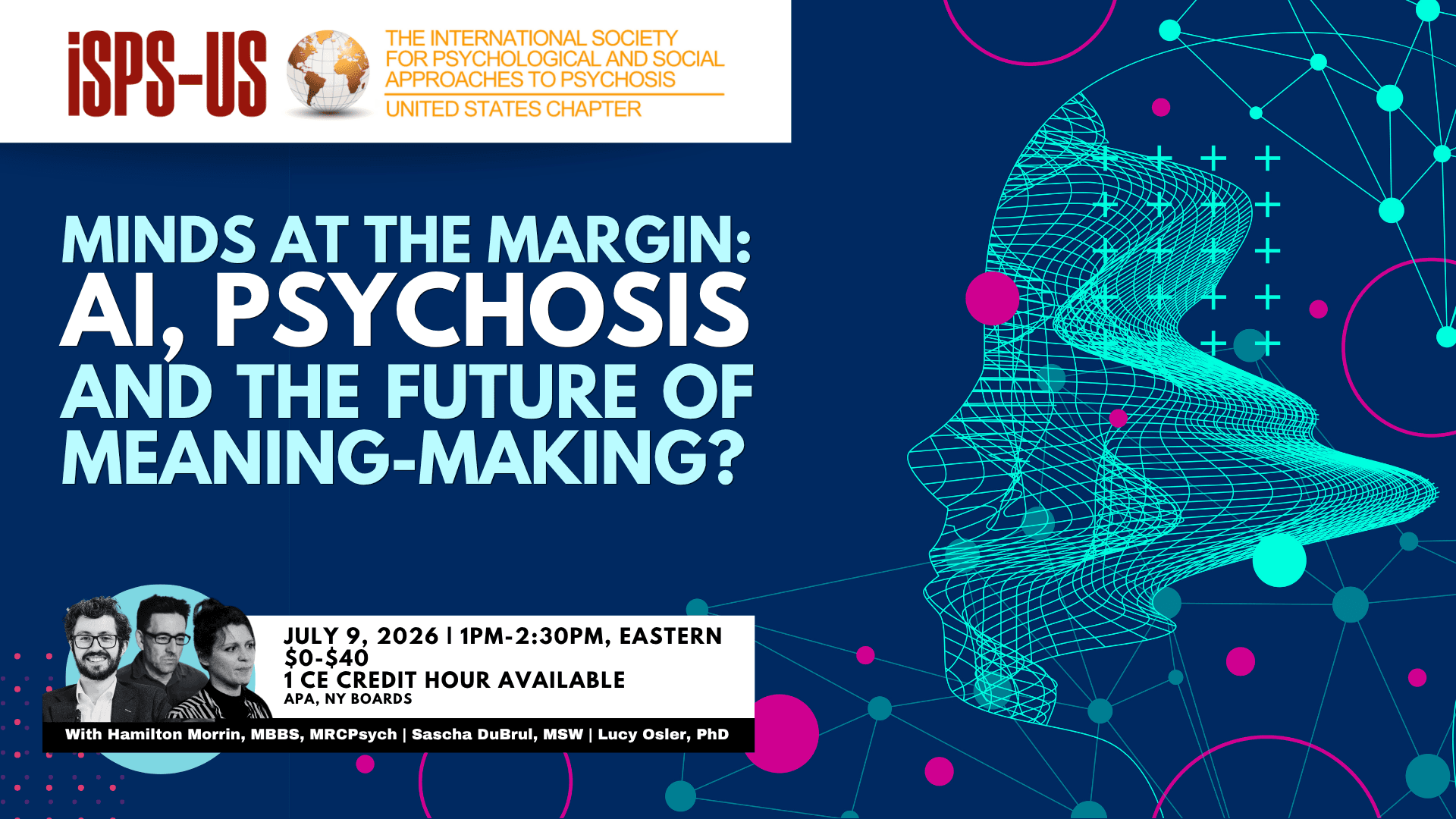
We are excited to announce our next webinar on Thursday, July 9th at 1pm Eastern, Minds at the Margin: AI, psychosis, and the future of meaning-making?, as we zero in on the most talked-about topic regarding psychosis in the media today: the link with AI.
We will be joined by Hamilton Morrin, psychiatrist and Wellcome Doctoral Fellow at the King’s College London Institute of Psychiatry; Lucy Osler, Philosophy Lecturer at Exeter University; and Sascha DuBrul, therapist, writer, activist, and expert by experience, as we deep dive into this vital topic.
Webinar Description
As Artificial Intelligence (AI) becomes part of everyday life, new questions are emerging about its relationship to psychosis, and the ways people make sense of themselves and the world around them. This webinar moves beyond simple questions of whether AI is “good” or “bad” for mental health, and instead explores how these technologies are reshaping experience, meaning-making, and reality itself.
This webinar brings together three perspectives on a rapidly developing topic. Hamilton Morrin will discuss emerging reports of AI-associated delusions and consider how conversational AI may influence belief formation, distress, and help-seeking. Lucy Osler will explore the role that other people play in shaping our sense of reality and ask what happens when AI systems enter into increasingly social relationships with us, potentially altering how reality itself is experienced and negotiated. Drawing on his lived experience of psychosis and extreme states, Sascha DuBrul will reflect on his encounters with AI and argue for an approach to technology that centers self-authorship, relational depth, and community epistemology over diagnostic efficiency. His talk draws on Internal Family Systems theory, and emerging work with locally hosted AI tools.
Drawing on philosophy, lived experience, clinical practice, peer support, and research, presenters will explore how AI may be influencing experiences of reality, belief, and meaning-making. Together, they will consider the opportunities, challenges, and ethical questions that arise as these technologies become increasingly embedded in mental health care and everyday life.
- Can’t attend live? The webinar will be recorded and sent to all registrants. CEs are available for watching the recording.
- Need CE credits? Choose the Professional Ticket, which includes CEs for APA & NY Boards. You’ll be able to attend the live webinar, and within 2 weeks of the event, we’ll send you a follow-up email with a link to the recorded session on our CE platform, CE-Go, along with a short quiz. CEs are awarded only after you complete the quiz; live attendance alone does not qualify. Further CE Info.
Presenter Bios
Sascha Altman DuBrul, MSW is a therapist, writer, and activist whose work sits at the intersection of serious mental illness, peer support, and the politics of care. He is the co-founder of the Icarus Project, a pioneering peer support network that has spent over two decades building an alternative language for madness and mental difference. He is the creator of T-MAPs, a community-based self-authorship tool that helps people with serious mental illness map their inner worlds and communicate their needs to the people around them. He is currently developing a locally-hosted AI project designed to support people in extreme states outside of centralized platform infrastructure. Sascha brings his own lived experience of psychosis and psychiatric hospitalization to his clinical work, his writing, and his ongoing commitment to building systems of care that treat meaning as medicine.
Hamilton Morrin is a psychiatrist and Wellcome Doctoral Fellow at the King’s College London Institute of Psychiatry, Psychology & Neuroscience, where he co-leads the LAMBDA research group (Looking After Minds and Brains in the Digital Age). His research examines how conversational AI systems may shape belief, emotion, and behavior, including recent work in the Lancet Psychiatry on AI-associated delusions. His current work includes collaboration with clinicians, researchers, and lived-experience partners, including The Human Line Project, to develop more careful ways of understanding and responding to distressing or destabilizing AI interactions. He is also a trustee for the UK mental health charity Gaming the Mind.
Lucy Osler is a lecturer in philosophy at the University of Exeter. Her research plays across the boundaries of phenomenology, philosophy of AI, and philosophy of emotions. She is particularly interested in our social and affective relationships with AI and how these shape our experiences of ourselves, others, and the world around us. Recent publications include “Hallucinating with AI: distributed delusions and ‘AI psychosis’”, “AI Gossip” (co-authored with Joel Krueger), and “Knowing oneself with and through AI”.
REGISTER ONLINE


