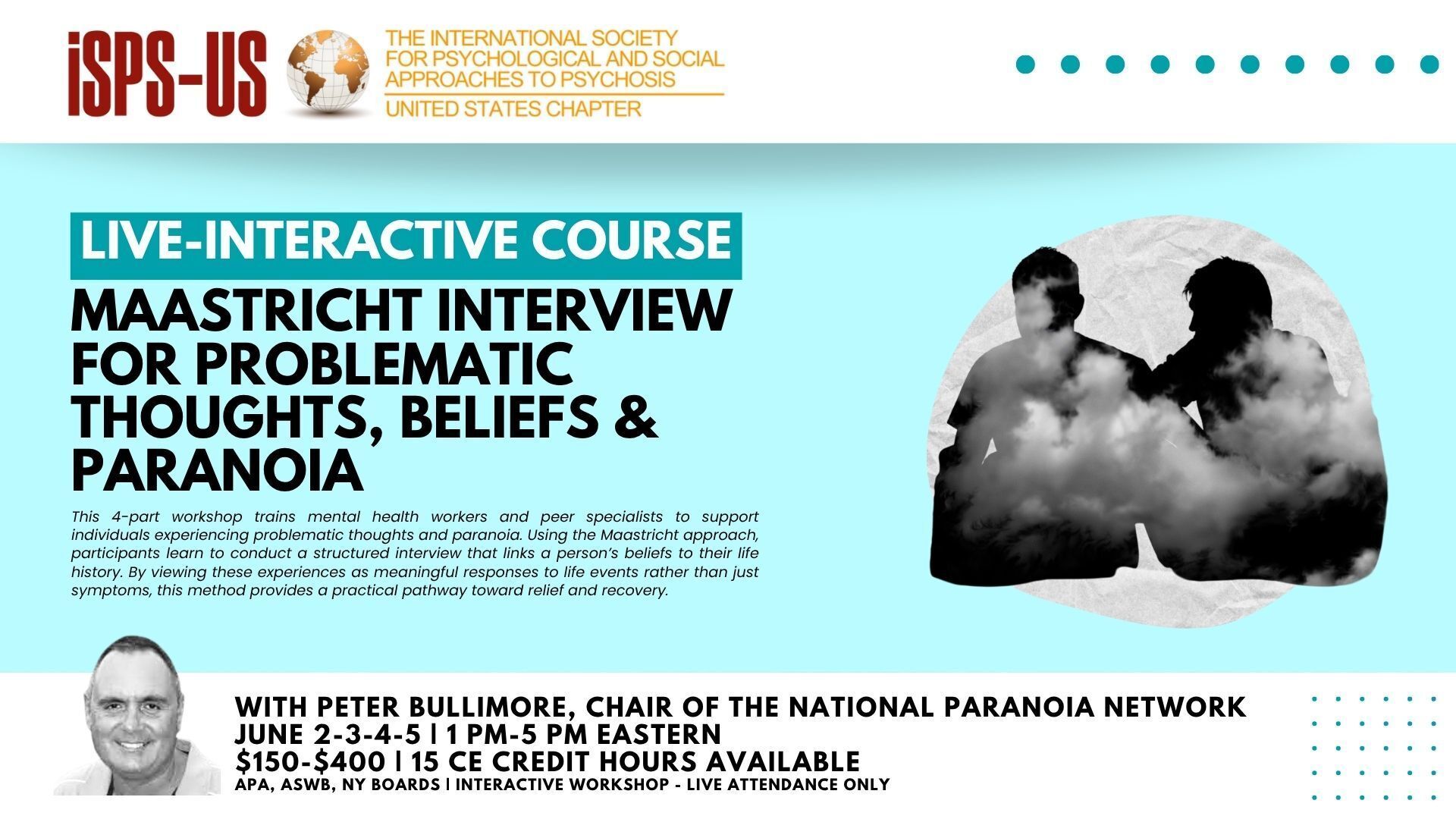
We are pleased to announce that following the success of last year's Maastricht Interview Training for Voices, we will be offering the Maastricht Interview Training for Problematic Thoughts, Beliefs & Paranoia this June!
Legendary lived-experience trainer Peter Bullimore, alongside colleagues from the National Paranoia Network, Shaun Hunt and Kate Crawford, will be delivering this highly interactive and experiential training from June 2nd-June 5th from 1pm-5pm Eastern.
As only 24 spaces are available, we encourage you to register early to avoid disappointment. Sliding scale fees from $150-$400.
Invite your colleagues: 10% discounts are available for groups of 3 or more registering together. ISPS-US members also recieve 10% off. The code is in the member portal.
Description
This workshop series provides training in the Maastricht Interview for mental health care workers, including psychologists, peer specialists, social workers, therapists, counselors, and others who support individuals experiencing problematic thoughts, beliefs, and paranoia.
The Maastricht approach involves accepting and making sense of a person’s thoughts and beliefs, and establishing a link between these experiences and the person’s life history, as a means of providing both relief and the possibility of recovery. It offers an alternative to traditional psychiatric frameworks, viewing paranoia and distressing beliefs not simply as symptoms of illness but as meaningful responses to overwhelming emotions and life events. Participants will gain an understanding of the historical, cultural, and experiential contexts of paranoia, and develop competence in conducting the structured Maastricht Interview for Problematic Thoughts, Beliefs & Paranoia.
The interview itself explores key areas such as the nature and characteristics of the thoughts and beliefs; personal history; triggers; the content and meaning of fears; personal explanations for their origin; the impact on daily life; relational and social contexts; and coping strategies. It also covers experiences in childhood, treatment history, and the person’s social network.
The workshop also provides an opportunity for participants to understand the underlying principles of this approach and practice skills by interviewing individuals who have been through the Maastricht interview process.
- The course is interactive and must be attended live
- CEs available for APA, ASWB, and NY Boards
We look forward to having you join us for what is set to be a vital conversation examining the global mental health landscape.


