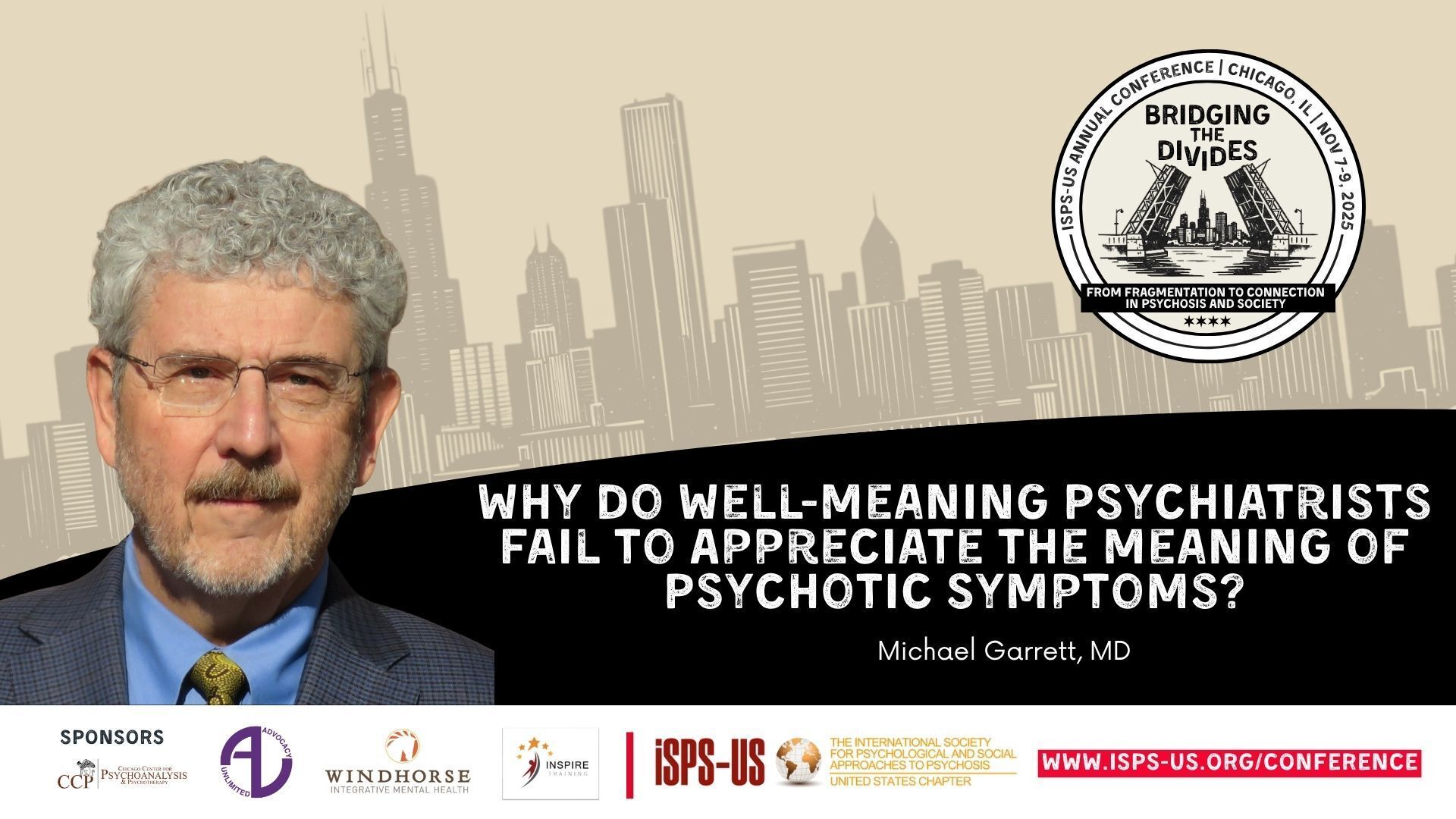
We are honored to release the recorded session by Michael Garrett, MD, from the ISPS-US 2025 National Conference.
As an expert in the integration of CBT and psychodynamic treatments, Dr. Garrett addresses a critical gap in psychiatric training: the tendency to prioritize pharmacological diagnosis over the personal, meaningful history of the patient.
"Psychotic symptoms are meaningful expressions of a suffering person’s current state of mind."
Presentation Description:
Currently, most psychiatrists receive little training in psychotherapy for psychosis. Typically, education and training focus on diagnosis and pharmacological treatment. The presenter will explore why otherwise well-meaning psychiatrists fail to appreciate that psychotic symptoms are meaningful expressions of a suffering person’s current state of mind that are expressive of a person’s past history. Drawing inspiration from the writings of Bertram Karon, the presenter will explore the following possible contributions to biological psychiatry’s neglect of meaning.
1) Fear of deviating from strict adherence to a biological model will expose the psychiatrist to malpractice claims and alienate them from fellow psychiatrists
2) Limitations in the psychiatrist’s capacity to empathize with psychotic states that lead to a seeming incomprehensibility of psychotic symptoms, which creates an insurmountable barrier to communication.
3) Fear of empathically registering the patient’s intense suffering. The clinician’s fear of losing their mind.
4) Fear that talking about a delusion will collude with the delusion, making the patient’s situation worse rather than better.
5) Being at a loss as to what to say when, after a psychiatrist fails to endorse a delusional belief, a patient says, “You don’t believe me!”
6) Trying to engage the patient will be an exercise in futility that is a waste of time
The presenter will offer several suggestions as to how one might bridge the gap between biologically committed psychiatrist, patients, and psychological practitioners.
About the Presenter
Michael Garrett, MD is currently Professor Emeritus of Clinical Psychiatry at SUNY Downstate Medical Center in Brooklyn, New York. He is also on the faculty of the Psychoanalytic Association of New York (PANY) affiliated with NYU Medical Center in New York City. He received his medical degree from the Albert Einstein College of Medicine and completed his residency training in Psychiatry at Bronx Municipal Hospital Center. He currently teaches and supervises clinicians doing psychotherapy for psychosis and is a consultant to several first-episode for psychosis teams in the United States and elsewhere. He has a particular interest in the integration of cognitive behavioral and psychodynamic treatment in the psychotherapy of psychosis, as detailed in a Chapter in Kaplan & Sadock’s Comprehensive Textbook of Psychiatry 11th Ed titled Individual Psychodynamic Psychotherapy and Cognitive Behavioral Therapy for Psychosis, and in his recent book, Garrett, M. (2019) Psychotherapy for Psychosis: Integrating Cognitive Behavioral and Psychodynamic Treatments. Guilford Press/New York.
Watch the full video on YouTube: https://www.youtube.com/watch?v=yCEGyDTBMEM


