
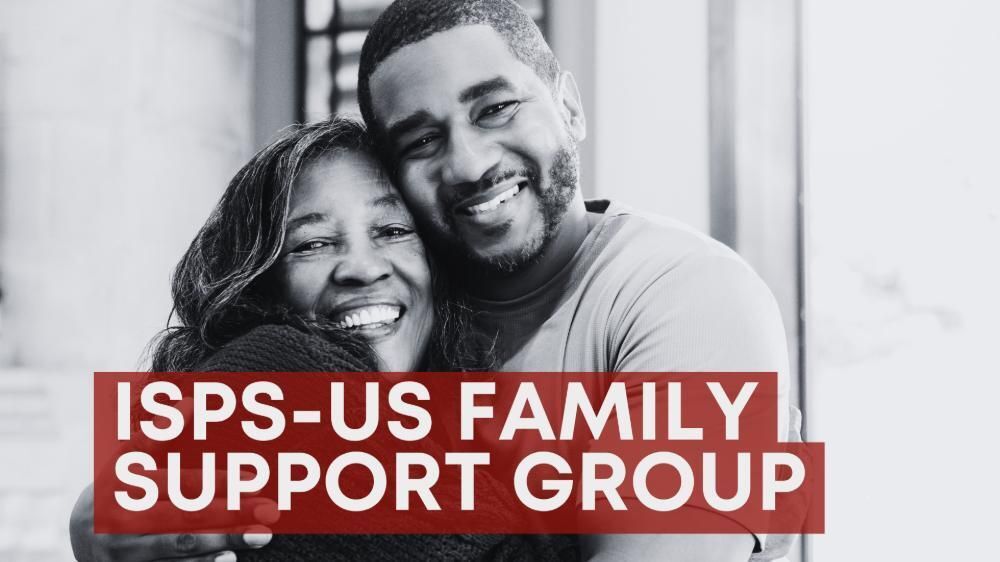


It is my wish as a facilitator to hold space where you feel heard and valued no matter what you are experiencing.
I believe that if we can practice being present and authentic with each other without being judgmental, this will support us in navigating the difficulties we face. It is my hope that if we learn how to be fully present with and listen to each other, we may become more skilled with those we love and live with. We are accompanying each other on this journey.
Here are a few ground rules that I find useful:
• Allow everyone who wants or needs to speak time.
• If one or two of us has something pressing or a need for more time, we allow for this.
• It is great to share information that we each have, but it is usually not helpful to give advice.
I am a board member of ISPS-US and came to this organization because I found a welcoming home here after navigating difficult experiences with my own family, a broken health care system, a stigmatizing community and extended family without understanding.
My husband and I have an adult son who experienced extreme and distressed states while attending college. He has been living with us since he graduated from college eleven years ago and does not work outside the home or for an outside employer. He has become easy to live with but seems incredibly isolated and limited in his activities. When we first became aware of his distress, we sanctioned the authorities to hospitalize him twice. Though both stays were relatively brief, he was given neuroleptics & trust was broken between us. In many ways, the interactions with the police and hospital staff were more traumatic than the events leading to the calls. Our son was terrified and we were terrified. Since those early psychotic episodes, my husband and I have learned to calm our fears, but our son still seems to be driven by his.
I am not a psychotherapist or social worker, but I have spent 48 years teaching a mind-body work called the Alexander Technique. It is a process that focuses on becoming aware of the habitual movement, psychological & thinking patterns that interfere with optimal functioning. As a teacher, it has always been my interest to empower my students to make their own discoveries. The process requires time and patience, from me and from my students. It is the ability to be present and patient that I hope to bring to our group.
We each make different choices, they are best choices at a given time, with the information and resources available. I personally, do not believe that psychosis is a brain disease nor in the efficacy of neuroleptic drugs; I have seen the harm done by such pharmaceuticals to far too many. Group attendees may hold differing perspectives. There is space for each of us.
Our journey is not easy. There are no pat answers. To borrow a phrase from Kermit Cole, “we are learning to tolerate uncertainty together”.
Interested in taking part in our groups? If you’re not already a member, join ISPS-US. If you’re already a member, check out our upcoming group meetings on our event calendar to register.


