
Join us Virtually for ISPS-US 25th Annual Conference, November 6-8th, 2026
Registration is Now Open for the International Society for Psychological and Social Approaches to Psychosis - US Chapter (ISPS-US)'s 2026 Conference, Psychosis and the Social Link
The event will take place from November 6-8th, 2026, at the John Jay College of Criminal Justice in New York City and hybrid online via Zoom.
In-Person tickets have almost sold out, but you can still join us virtually!

Virtual/Hybrid Schedule
Check out all the sessions that will be streamed live to you and recorded for watching in your own time. Recorded sessions will be available for at least 3-months post event.
Friday, November 6
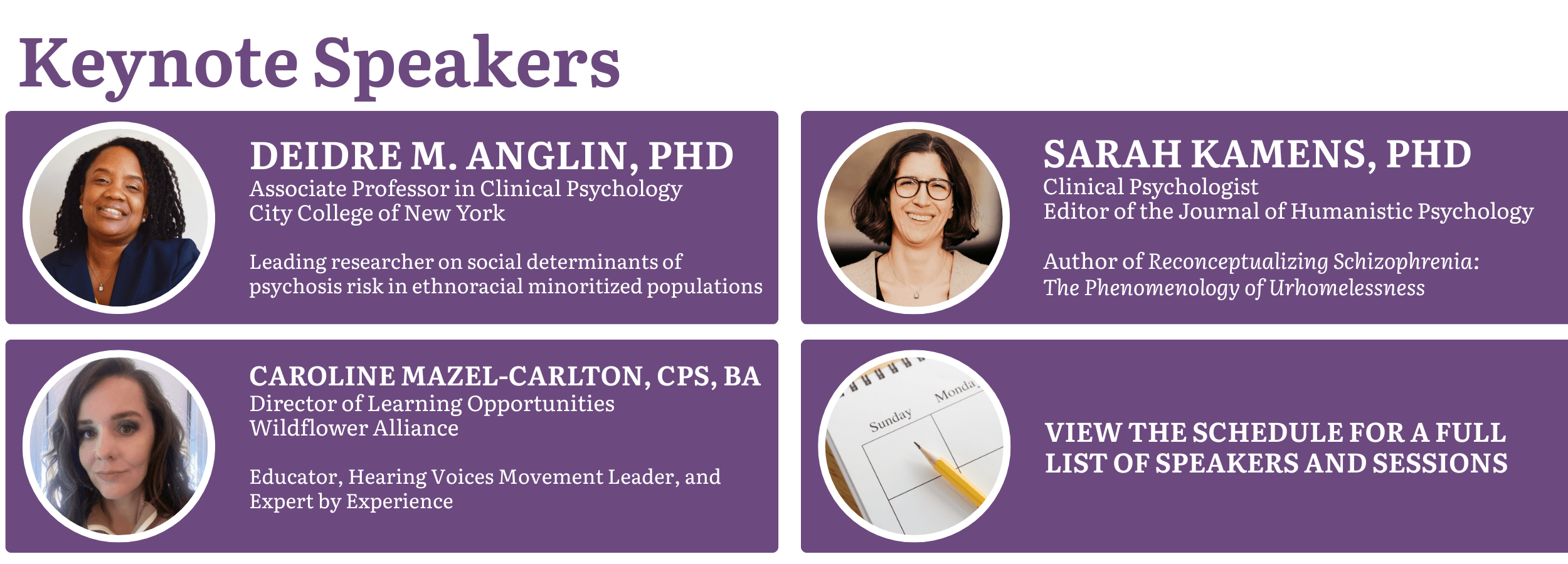
- Keynote: The Hope of Harm Reduction: New Strategies for Building Connection Across Realities - Caroline Mazel-Carlton, CPS, BA
- Keynote: Urhomelessness: Understanding Psychosis as a Person-World Experience - Sarah Kamens, PhD
- Beyond Coercion: Reimagining Legal Responses to Psychosis
- Everyday Coercion: Interrogating the Economic, Social, and Procedural Costs of Assisted Outpatient Treatment — Nev Jones, PhD; Todd Wittenberg; Melissa Uehling, MD, PhD; Lauren Fowler; Shannon Pagdon, MSW
- INSTEAD Mental Health Diversion: An Off-ramp to Care and Support for Individuals Arrested While in "Psychosis" or Extreme States — Allie Dougharty, LCSW
- Virtual Meet & Greet with Ellenhorn
- The Transformative Power of Peers
- The Role of Peer Specialists & Radical Powerlessness — Abaigeal (Abbe) Duke; Elise Diamond
- Redefining Community and Enlarging Connection: Peer Support on Discord from Wildflower Alliance — Claudia Wilson, MSW, MFA; Michal Ditkoff
- The Peer Message in the Psychiatric Hospital — Patrick Kaufmann, CPSS, CPRC, BS; Shannon Kaufmann, CPSS
- Young People, Families, and Recovery in Early Psychosis
- Family Recovery in First Episode Psychosis: Perspective from Georgia’s Peer Workforce and Team Leads — Beth Broussard, MPH, CHES; Emily Griner, MPH; Sophie Pollack-Milgate, BA; Angie S. Williams
- Negotiating Identities: Supporting Recovery During the Transition to Adulthood — Michaela I. Fissel, MA
- Disalienation as System Change: Relational and Community Approaches to Recovery
- Alienation, Trauma, and the Voice That Speaks: Understanding Psychosis Spectrum Experiences Through a Social-Relational Lens — Carina A. Iati, PsyD; Jeannie Bass, CPS
- Intentionally Designed Housing as Key to Social Connections and Improved Health — Joël Doty, MBA
Saturday, November 7
- Keynote: Racial Disparities in Psychosis: Why Social Factors and Neighborhoods Matter - Deidre M. Anglin, PhD
- Plenary Panel: The Impact of Involuntary Outpatient Commitment: Findings from a Comprehensive Evaluation of New York State’s Assisted Outpatient Treatment Program - Nev Jones, PhD; Philip Yanos, PhD;Pablo Sadler, MD, MPH
- Madness and the Social Link: Forty Years of Our Paris Seminar - Francoise Davoine, PhD
- Three People, One Lineage: Psychosis, Social Fracture, and What Healing Actually Requires — A Collaborative Lived Experience Panel in Three Voices - Neelam Khawani-Connett, BA (Hons), IGA; Anuckriti Garg, BA, MSW; Acquilin John, MSc
- Transforming Mental Health Systems Through Lived Experience Knowledge
- Can an Alternative Become an Addition? Implementing Hearing Voices in Health Systems — Alison Branitzky, PhD; Cindy Marty Hadge, BS, IPS; Sahastri Hercules, BS; Erica Hua Fletcher, PhD; Ippolytos Kalofonos, MD, PhD, MPH
- What We Bring to the Table: Lived Experience, Co-Creation, and Resisting Stigma in Research — Rosalba Perez; Laura López-Aybar, PhD
- The Right to Make Meaning: Mysticism, Art, Culture, and Agency
- The Shape of Air: Colonial Psychiatry, Medication Violence, and Film as Witness — Jennifer Abbott
- Reframing Mysticism: An Ethic of Agency and the Other in Psychosis — Jacob Sirkisoon Prescott, LMSW
- From Homelessness to Home: Housing, Relationships, and Recovery
- Twenty Years of INSIGHT FOR ALL: Long Term Psychotherapy with Homeless Adults — Deborah Luepnitz, PhD
- Housing as an Anchor in Psychosis: From Intensive Mobile Treatment to Supportive Housing, Providing Treatment Across the Housing Spectrum — Judith Katz, MD; Sadie Heald, LMSW
- The Clinician in the Room: Projection, Power, and Moral Injury in Psychosis Care
- Unrecognized and Untreated: Moral Injury Associated With Psychiatric Hospitalization — James Black, MD, PhD; Wendy Haight, PhD
- Whose Insight Is it Anyway? Therapist Projection and the Folly of Targeting Anosognosia — Lionel Wininger, PhD
- Virtual Meet & Greet with Ellenhorn
Sunday, November 8
- Plenary Panel: Beyond the Individual: The Past, Present, and Future of Family-Inclusive Psychosis Care - Justin Palanci, MD; Sydney Laurel Harris; Justin Garson, PhD
- ISPS-US Awards Ceremony
- Women and Psychosis: Trauma, Testimony, and Structural Violence - Nadia Naomi Mbonde, PhD; Leah Giorgini, MS; Marie Brown, PhD, ABPP; Erika Carr, PhD
- Making Meaning of Psychosis: Phenomenology and Lived Experience
- The Psychological Greenhouse: A Phenomenological Framework for Understanding Psychosis-like Experience and Recovery — Wenmao Ma; Xinru Yi
- The Importance of Diversifying Causation Beliefs in Support Groups for Psychosis — Timothy C. Dreby, MEd, LMFT
- The Uninvited Guest: Psychosis, Pedagogical Failure, and the Analyst Who Is Unprepared - Danielle Knafo, PhD
- Decarcerating Crisis Responses
- Decarcerating Care: Building Community Responses Beyond Police and Psychiatry — Kimberlee Kristel Lalane, MA; Evan Auguste, PhD; Jessie Roth; Coreena Forstner, MSW
- Crisis Alternatives in a Carceral World — Alexander Campanario Araica; Keith Scott; Sera Davidow
- Student Experiences of Psychosis: Cultural Alienation, Meaning-Making, and Systems of Care
- The Storm That Helps You Notice How Far You Are From Land: International Students Whose Extreme Experiences Helped Us to Identify and Address Forms of Social and Cultural Alienation — Olivia Wills, MSW, LCSW
- Countertransference and Containment in Acute Response Strategies for Students Presenting With Psychosis in University Residence Hall Contexts — Neil Haran, MS; Rachel Rahman, BA
- Expanding Psychosis Care: Integrating Creativity and Community
- Integrating Evidence and Meaning: Rethinking Psychosis Care through Clinical, Creative and Lived Experience Perspectives — Lorna Collins, PhD, FHEA, FRSPH, FRSA; Anthony David, PhD; Roxana Baiasu, PhD, SFHEA
- Whatever Happened to Disalienation? From Theatre to Shared Stories: Collective Cultural Practices as a Response to Psychosis — Boglarka Hardy
- A Kathak Autobiographical Performance Using Drama, Prose of a South-Asian Woman’s Lived Experience in Madness, Sexuality, Patriarchy, & Intimate Partner Violence — Ishaa Vinod Chopra, RECE, MSc Candidate
Wherever you’re joining us from, we hope you’ll be part of these conversations.
Theme
Psychosis is overwhelmingly understood by dominant mental health systems as a problem of the individual: a disease, deficit, or disorder, to be treated by medication and, less frequently, psychotherapy. An enhanced way of approaching psychosis is not merely to conceptualize it as something that exists solely within a person, but as something that emerges in relationship with the social link.
In the aftermath of World War II, a group of French psychiatrists reconceptualized psychosis (or “madness”) as most importantly a social phenomenon, rooted in experiences of intensive social alienation. This movement considered psychotherapeutic treatment to be, foremost, a process of “disalienation”: the undoing of profound social disconnection through community and social engagement. Individual treatment was thus integrated with social treatment, aimed at healing both the individuals within a therapeutic community and the community itself.
ISPS-US’s landmark 25th Annual Conference seeks to re-engage with this thinking as we face a resurgence of policies and practices that further entrench states of alienation, including the expansion of civil psychiatric commitment, and a broader social context in which many, particularly those most affected by racial and economic inequities, displacement, or homelessness, are pushed further to the margins. Appreciation of the social determinants of psychological suffering leads us to an essential question: Rather than being incomprehensible, is psychosis, in fact, an expression of society’s fractures?
New York City serves as a powerful setting for grappling with these questions. As a city of over 8 million people with immense diversity, New York is paradoxically a very social place, and also one of potentially profound social isolation. Many come because their “home” was untenable due to war, disaster, oppression, or simply not fitting in. Therefore, to be a New Yorker is often to be an outsider, bound with other New Yorkers by difference and the attempt to find one’s footing in community. In this way, New York serves as a metaphor for understanding psychosis and the social link – not only as an individual experience, but as something that unfolds within the tensions of connection, disconnection, and the search for belonging.
See you in New York City in November 2026!
Visit the Conference Site
Conference News

The wait is over! We are delighted to announce that the preliminary schedule for the 25th Annual ISPS-US Conference: Psychosis and the Social Link is now available.
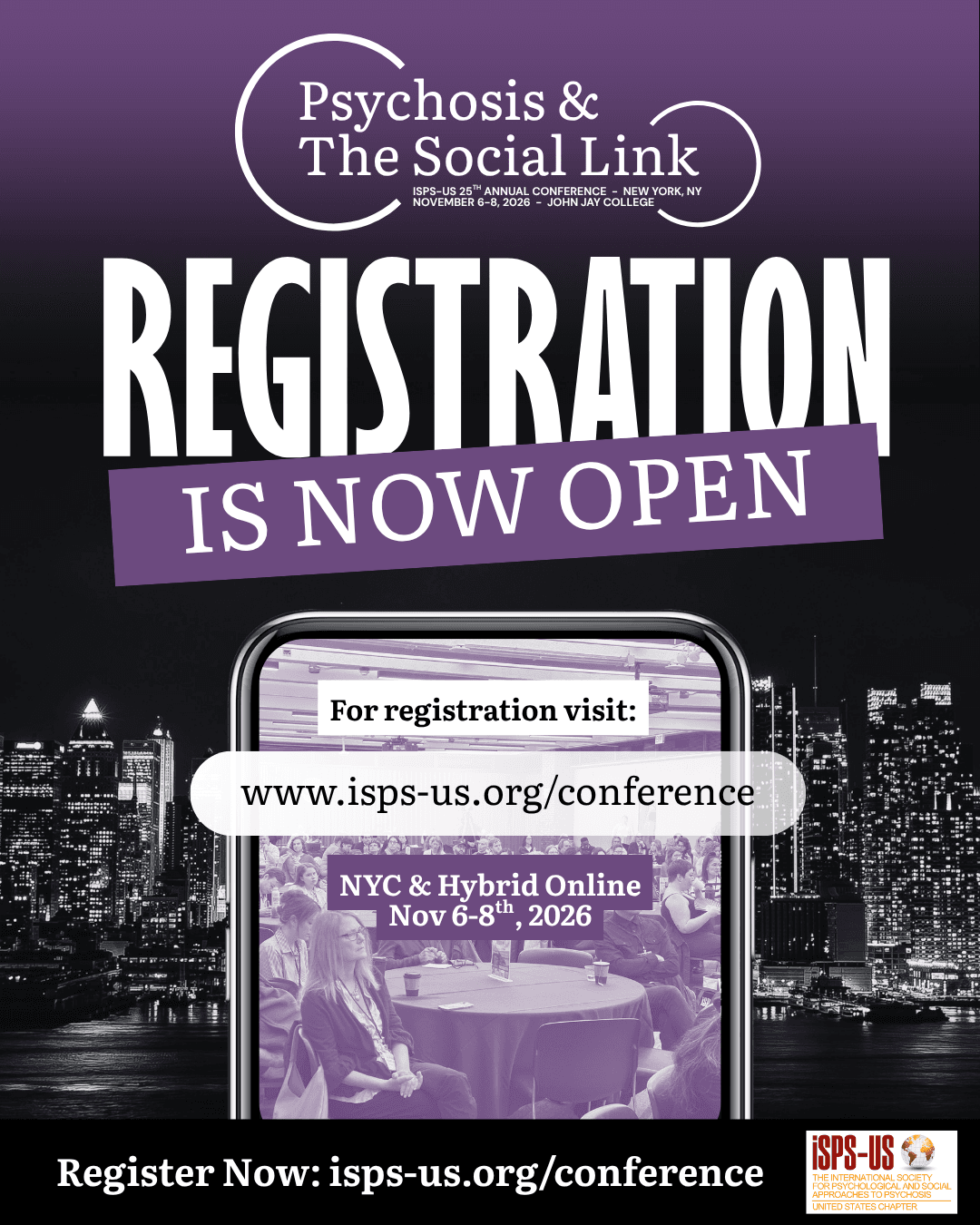
We are thrilled to announce that registration is officially open for our landmark 25th Annual Hybrid Conference, Psychosis and the Social Link, taking place in New York City and online via Zoom.
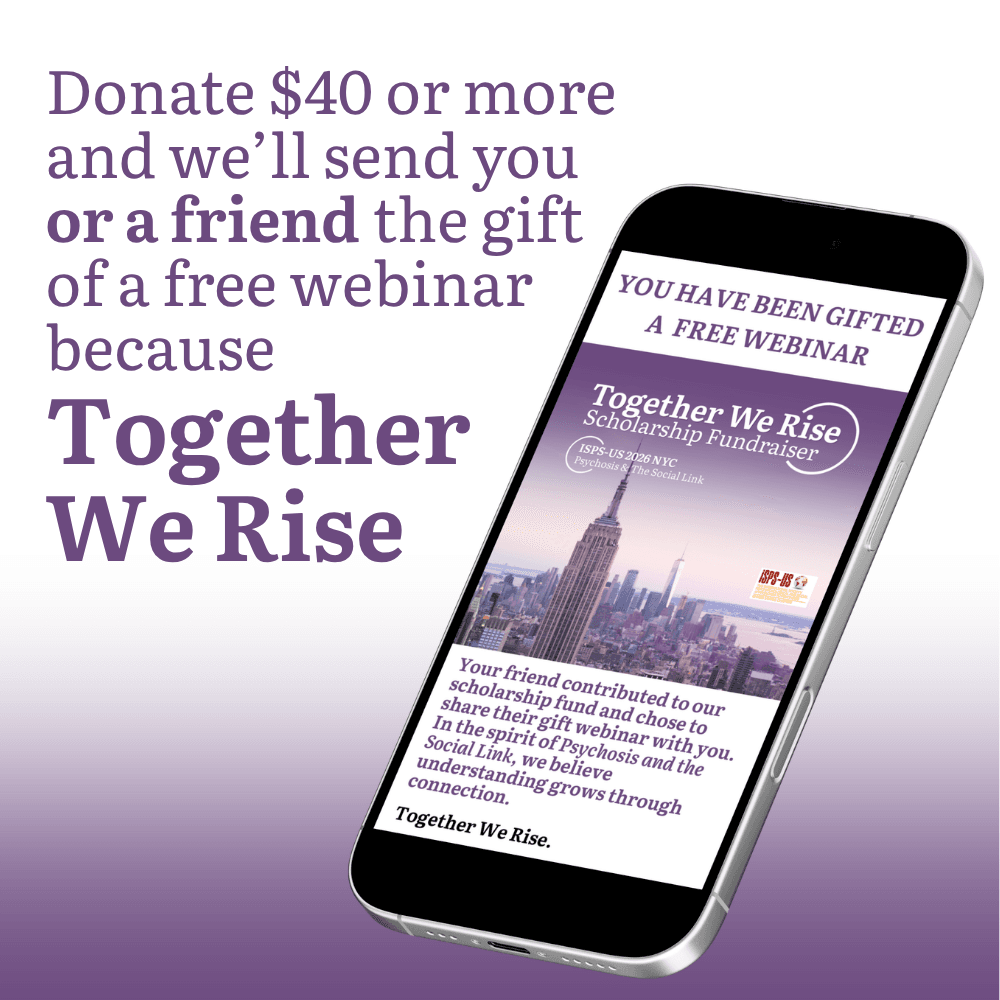
Help us reach our $4,000 goal! Learn how your donation to the Together We Rise scholarship campaign ensures that peers, students, and underrepresented voices can fully participate in the upcoming ISPS-US 2026 Annual Conference.
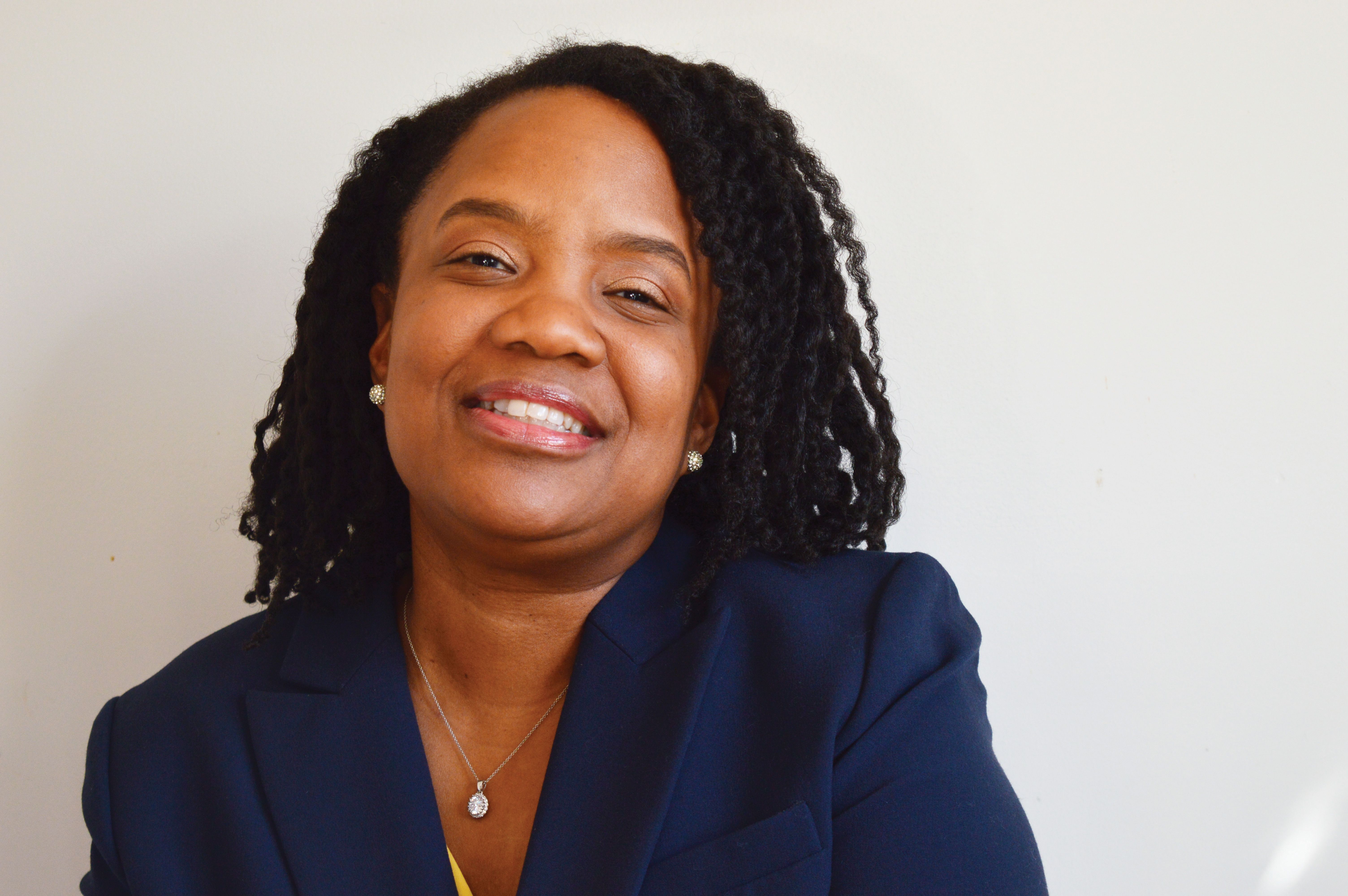
ISPS-US is thrilled to announce our second keynote speaker, Dr. Deidre Anglin, for our 2026 Annual Conference, Psychosis & The Social Link, taking place November 6-8 in New York City and hybrid online.
Sponsors